


Local SEO has changed more in the last 18 months than in the previous decade. By 2026, the concept of “ranking” has fractured. Your customers are no longer just looking at the “Local Pack”—they are getting answers from AI Overviews, voice assistants, and interactive maps.
If your agency is still relying on tools that only track static keyword positions, you are seeing less than 50% of the picture.
We tested the top platforms on the market to find which ones can handle the 2026 “Search Everywhere” standard. We evaluated them on AI tracking capabilities, pricing models, and automation features.
Below is the definitive list of local SEO tools for agencies, multi-location brands, and growth-focused businesses.
What are the Top 19 Local SEO Tools for 2026?
| Tool | Focus | AI Tracking? | Pricing Model | Free Trial |
|---|---|---|---|---|
| 1. Local Dominator | Search Everywhere (AI + Maps + SERP) |
Yes (Native) | Rollover Credits | No |
| 2. BrightLocal | General Management | Limited | Per Location | Yes |
| 3. Semrush Local | General SEO Suite | Yes (Add-on) | Per Location | Yes |
| 4. Whitespark | Citation Finding | No | Per Feature | Limited |
| 5. Local Falcon | Rank Data | Yes | Credit-Based | Yes |
| 6. Moz Local | Listing Sync | No | Per Location | No |
| 7. Yext | Enterprise Listings | Yes (Scout) | Custom (High) | No |
| 8. Birdeye | Reputation | Yes (Search AI) | Custom | No |
| 9. SOCi | Franchise Mgmt | Yes (Genius) | Custom | No |
| 10. Uberall | Global Listings | Yes (UB-I) | Custom | No |
| 11. Synup | Mid-Market Mgmt | No | Per Location | No |
| 12. Chatmeter | Sentiment Analysis | No | Custom | No |
| 13. Reputation | Healthcare CX | No | Custom | No |
| 14. Podium | Messaging | No | Per Location | Yes |
| 15. Advice Local | Reseller Services | No | Per Location | No |
| 16. Rio SEO | Retail Pages | No | Custom | No |
| 17. Localo | SMB Tasks | Yes | Per Location | Yes |
| 18. Nightwatch | SERP Tracking | No | Per Keyword | Yes |
| 19. Places Scout | Lead Gen Audits | No | Custom | Yes |
1. Local Dominator (Top Choice for 2026)
Local Dominator is a powerful platform engineered specifically for the 2026 “Search Everywhere” landscape. While legacy tools act as separate silos for different tasks, Local Dominator integrates three core technologies—AI Tracking, SERP Tracking, and Citations Management—into a single command center. This allows you to control your brand’s narrative across Google Maps, Organic Search, and Generative AI simultaneously.

What is Local Dominator Best For?
It is the primary choice for growth-focused agencies and multi-location brands that need to prove ROI across all search surfaces. Its unique “Rollover Credit” model makes it the most profitable choice for agencies scaling from 10 to 500+ locations.
What are the Best Features of Local Dominator?
AI Tracker: This monitors your “Share of Voice” inside AI models like ChatGPT, Gemini, and Google AI Overviews. Crucially, it detects AI Hallucinations—instances where AI gives users incorrect info about your hours or services. You get alerts so you can fix the data source immediately before it costs you a customer.
High-Fidelity GeoGrids: Visualizes ranking decay block-by-block. It doesn’t just give you a number; it shows you exactly which neighborhoods you own and where you are invisible.
Local SERP Tracker: While GeoGrids cover the Map Pack, the SERP Tracker monitors your traditional organic rankings. This gives you a complete view of the page: are you winning the Map Pack and the organic links below it? This dual visibility is the key to dominating click-through rates.
Integrated Citation Builder: AI models rely on consistent data across the web to verify facts. The Citations Builder scans the web to find listings with old, incorrect data that confuse AI. It then helps you fix them, feeding accurate data to the Knowledge Graph to boost your authority
Agency-First Economics: Unlike competitors who charge per location, Local Dominator uses a credit pool. Unused credits roll over, allowing agencies to bank resources for heavy audit months.
What Is the Pricing Structure of Local Dominator?
Local Dominator uses a scalable credit model ranging from $39/month for beginners up to $399/month for large enterprises. The key differentiator is the Rolling Credits feature, which allows unused credits to carry over to the next month, so you never lose what you pay for. Higher tiers unlock access to the Citations Builder, increased GBP connections, and SERP tracking.
2. BrightLocal
BrightLocal is a widely used platform in the local search industry. It offers a general suite of tools that covers standard tasks such as citation tracking, manual submissions, and review monitoring.

What is BrightLocal Used For?
It is often used by general agencies that require manual submission services. Their team provides a service to update business listings on various directories for a fee.
Key Features
Manual Submission Service: A team that submits your business details to directories.
Audit Reports: Generates a PDF report checking on-site SEO and directory listings.
Review Tools: Basic functionality for monitoring reviews and sending requests via SMS/email.
Pricing Structure
Plans start at $39/month per location. The cost increases for each additional location added to the account.
3. Semrush Local
Semrush Local is an optional module for users of the Semrush marketing suite. It connects with the Yext network to distribute business data to directories.

What is Semrush Local Used For?
It is designed for general SEOs who prefer to keep their local data management within the main Semrush interface rather than using a separate platform.
Key Features
Listing Sync: Distributes business info to supported directories via API.
Basic Map Tracking: A heatmap tool for visualizing rankings in a specific area.
On-Page Audit: Checks pages for basic local SEO elements.
Pricing Structure
Semrush Local operates as an add-on to the main Semrush ecosystem. To access the local tools, users generally require an active subscription to a base Semrush plan first. The local features are then purchased for an additional monthly fee per location. There are two tiers of local service (Basic and Premium), with the total cost reflecting both the core software subscription and the cumulative fees for each location managed.
4. Whitespark
Whitespark is a toolset focused primarily on the discovery of citation opportunities. It is not an all-in-one platform but offers specific utilities for finding directories.

What is Whitespark Used For?
It is used by SEOs who need to find specific directories where a business is not yet listed.
Key Features
Citation Finder: Scans competitors to list directories they appear on.
Rank Tracking: Differentiates between Local Pack and organic positions.
Submission Service: A manual service for building citations on a pay-per-item basis.
Pricing Structure
Whitespark uses a modular pricing model where tools are unbundled. Users must purchase separate subscriptions for the Rank Tracker, Citation Finder, and Reputation Builder individually, rather than accessing them through a single all-in-one plan.
5. Local Falcon
Local Falcon provides data visualization for map rankings. It focuses on generating grid reports rather than offering management features.

What is Local Falcon Used For?
It is used by analysts who need raw ranking data and visual heatmaps but do not require integrated tools for posting or review management.
Key Features
Share of Local Voice: A metric that summarizes visibility percentages.
Apple Maps Scans: Offers specific tracking for Apple Maps results.
Looker Studio Connector: Pipes ranking data into Google Looker Studio.
Pricing Structure
Operates on a credit system starting at $24.99/month.
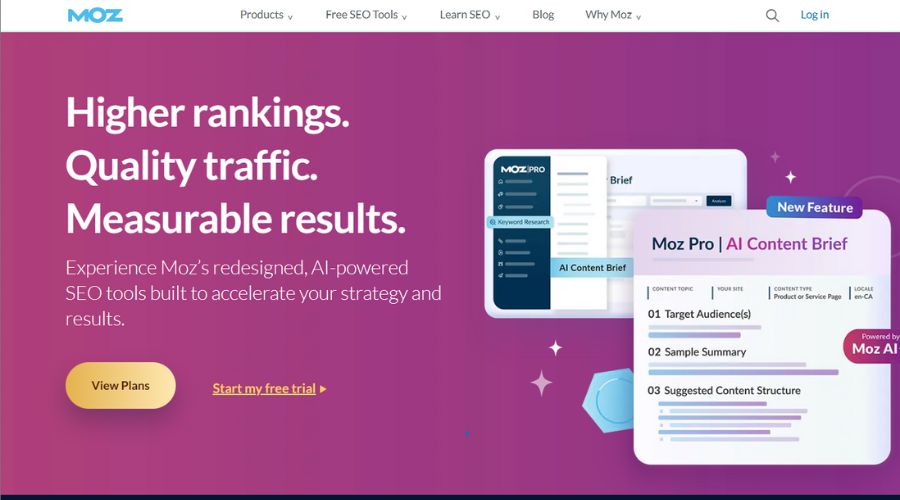
6. Moz Local
Moz Local is a tool for data synchronization. It focuses on pushing business information to major aggregators and directories.
What is Moz Local Used For?
It is used by small businesses looking for a way to sync their hours and address across common platforms.
Key Features
Data Sync: Pushes data to Google, Facebook, and other platforms.
Duplicate Check: Identifies duplicate listings on supported directories.
Profile Scoring: Provides a score based on the completeness of the profile.
Pricing Structure
Plans start at $14/month per location (Lite plan, billed yearly).
7. Yext
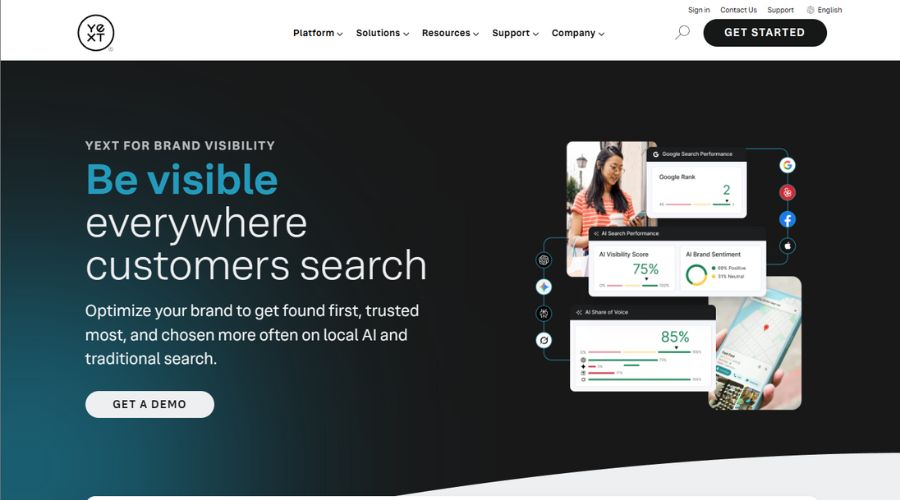
Yext is an enterprise platform for managing brand data. It focuses on maintaining a centralized database of business facts for large organizations.
What is Yext Used For?
It is utilized by large corporations with significant budgets that need to manage data across hundreds of locations.
Key Features
Knowledge Graph: A database structure for organizing brand facts.
Direct API Connections: Updates data on publisher sites through API feeds.
Scout: A feature for monitoring brand mentions in search experiences.
Pricing Structure
Pricing is custom and typically involves an annual contract.
8. Birdeye
Birdeye is a platform focused on customer experience and reputation. It centers on review collection and customer communication.

What is Birdeye Used For?
It is used by service businesses that prioritize review generation and messaging consolidation.
Key Features
Search AI: A toolset for optimizing profiles for AI visibility.
Unified Inbox: Aggregates messages from SMS, Webchat, and social media.
Review Requests: Campaigns for requesting customer feedback.
Pricing Structure
Pricing is custom based on the number of locations.
9. SOCi
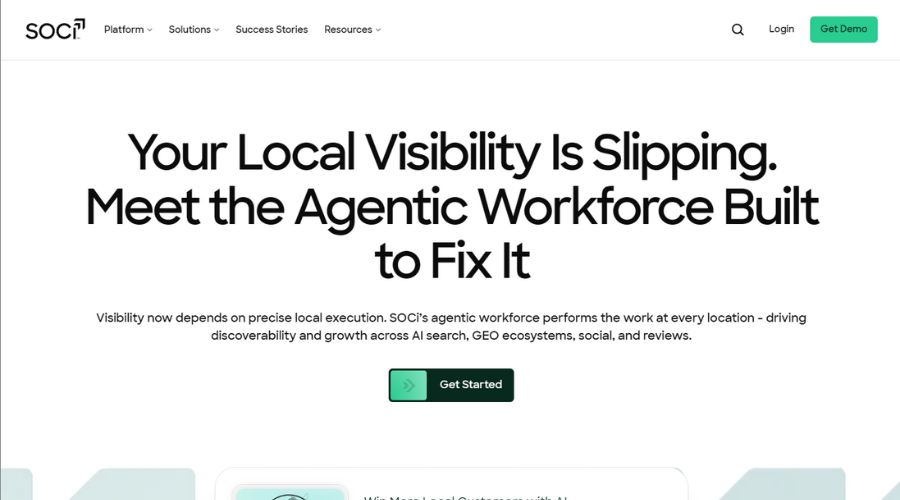
SOCi is a platform built for franchise management. It offers tools for controlling social media and listings across multiple locations.
What is SOCi Used For?
It is designed for franchise networks that need to balance corporate oversight with local franchisee access.
Key Features
Genius AI: Automation features for review responses and social posts.
Content Libraries: Allows corporate teams to distribute assets to local pages.
Listings Management: Basic management of location data.
Pricing Structure
Pricing is custom based on location count.
10. Uberall
Uberall is a location marketing platform that connects online searches to offline stores. It offers modules for listings and locator pages.

What is Uberall Used For?
It is utilized by global brands that need to manage presence across multiple countries.
Key Features
Location Marketing: A platform for managing listings and reviews.
AI Assistant: An agent that identifies potential optimizations.
Locator Pages: Tools for creating store finder pages.
Pricing Structure
Pricing is custom for enterprise clients.
11. Synup
Synup provides a dashboard for managing local listings and media. It offers an interface for updating business information.

What is Synup Used For?
It is used by mid-market companies that want a dashboard for managing listings and media assets.
Key Features
Voice Search Audit: Checks how a business appears on voice assistants.
Media Management: Tools for updating photos and menus.
Review Tracking: Monitors reviews from industry-specific sites.
Pricing Structure
Pricing starts at $79/month (billed annually for the Startup plan).
12. Chatmeter
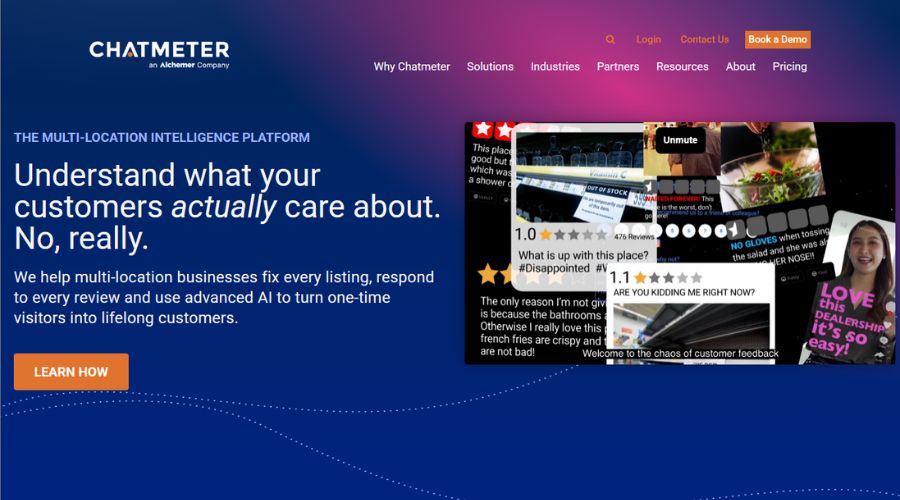
Chatmeter focuses on brand intelligence and sentiment analysis. It processes review text to find trends.
What is Chatmeter Used For?
It is used by retail chains to analyze customer sentiment and operational feedback from reviews.
Key Features
Pulse: An AI tool that analyzes text in reviews.
Visibility Score: A metric for tracking brand health.
Benchmarking: Compares locations against local competitors.
Pricing Structure
Pricing is custom.
13. Reputation
Reputation (formerly Reputation.com) is a platform for customer experience management. It includes surveys and social listening tools.

What is Reputation Used For?
It is frequently used in the healthcare and automotive sectors for compliance-focused review management.
Key Features
Surveys: Tools for gathering customer feedback.
Social Listening: Monitors brand mentions on the web.
Business Listings: Management of data sets for complex organizations.
Pricing Structure
Pricing is custom and enterprise-focused.
14. Podium
Podium is a communication platform that started with messaging. It includes tools for payments and reviews.

What is Podium Used For?
It is used by local service businesses to communicate with customers via text and collect payments.
Key Features
Text-to-Pay: Facilitates payments via SMS.
Webchat: Converts website visitors into text conversations.
Review Requests: Text-based review invitations.
Pricing Structure
Plans start around $289/month.
15. Advice Local
Advice Local operates as a backend solution for agencies. It focuses on data syndication and submission services.

What is Advice Local Used For?
It is used by agencies to outsource citation cleanup and data submission tasks.
Key Features
Data Cleanup: A manual process for correcting bad data.
rtical Directories: Submissions to industry-specific sites.
Voice App Submission: Submits data to voice platforms.
Pricing Structure
Pricing is per location and customized based on agency needs. Agencies must contact the provider for a quote.
16. Rio SEO
Rio SEO offers a platform for retail brands. It focuses on store locators and local landing pages.

What is Rio SEO Used For?
It is used by enterprise retail brands to manage store locators and local pages.
Key Features
Local Pages: Creates landing pages for store locations.
Reporting: Aggregates data from various platforms.
Open Platform: Integrates with other enterprise tools.
Pricing Structure
Pricing is custom.
17. Localo
Localo (formerly Surfer Local) uses AI to generate task lists. It is designed for small business owners.

What is Localo Used For?
It is used by small business owners who want a checklist of tasks to improve their profile.
Key Features
Weekly Tasks: Generates a list of actions based on data.
Post Writer: AI tool for writing Google Posts.
Audit: Checks the Google Business Profile for basic issues.
Pricing Structure
Plans start at $29/month per location.
18. Nightwatch
Nightwatch is a rank tracking tool with a focus on UI design. It tracks global and local rankings.

What is Nightwatch Used For?
It is used by SEOs who need to track keyword rankings across different search engines and locations.
Key Features
SERP Features: Breakdown of SERP elements like videos and snippets.
Global Data: Tracks rankings from various locations.
Visual Reports: Customizable graphs for reporting.
Pricing Structure
Plans start at $39/month.
19. Places Scout
Places Scout is an auditing tool. It is often used for lead generation reports.
What is Places Scout Used For?
It is used by lead generation agencies to run bulk audits on potential clients.
Key Features
Lead Gen Reports: Generates PDF audits for prospects.
Ranking Reports: detailed view of organic and map rankings.
Citation Analysis: Finds inconsistencies in citations.
Pricing Structure
Pricing is custom based on volume.
Buying Guide: How to Choose the Best Local SEO Tool for 2026?
Choosing a tool stack in 2026 is no longer just about tracking keywords. It is about business survival in a fragmented search landscape.
When you evaluate a platform, ignore the vanity metrics. Most tools can track a keyword. Very few can help you build a defensive infrastructure against competitors and AI changes.
Focus on these three critical factors to make the right choice:
Does it track the entire search ecosystem?
In the past, you only needed to track Google Rankings. Today, your customers might find you through a voice search, an interactive map, or a conversation with ChatGPT.
If your tool only tracks static keyword lists, you are missing half the picture. You need a platform that offers a “Command Center” view.
The Requirement: Look for a tool that integrates AI Tracking (for conversational answers), GeoGrids (for hyper-local map visibility), and SERP Tracking (for traditional organic results) into one dashboard.
The Benchmark: Platforms like Local Dominator allow you to overlay these different datasets. You can see if you are winning on the map and if ChatGPT is recommending you as a trusted choice. If a tool cannot see inside AI models, it is already obsolete.
Does it track the entire search ecosystem?
For agencies, software costs are often a “tax on growth.” Most legacy platforms charge a flat fee per location (e.g., $30/month per client).
This model punishes you for growing. If you sign a franchise client with 100 locations, your software bill instantly jumps by thousands of dollars.
The Requirement: Avoid “per location” fees if you are scaling an agency. Look for Credit-Based Models with rollover capabilities.
The Benchmark: Tools like Local Dominator or Local Falcon allow you to buy a pool of credits. You can use these credits heavily for a new client audit in Month 1, and then use fewer credits for maintenance in Month 2. The unused credits roll over, protecting your bottom line.
Is it Action-Oriented?
Data is useless without action. Many tools dump thousands of rows of data on you but don’t help you fix the problems.
In the age of AI, speed matters. If an AI model “hallucinates” (invents) a wrong phone number for your business, you cannot wait for a monthly report to find it.
The Requirement: Look for “closed-loop” systems. The tool should alert you to a problem and give you the button to fix it on the same screen.
The Benchmark: The best modern tools integrate Citation Building and GBP Management directly with the tracker. If you see a ranking drop in a specific neighborhood, you should be able to post a localized update or fix a bad citation instantly without switching tabs.


