


Entity optimization helps search engines and AI systems treat your business as a real-world entity. Without this structured proof, search engines may ignore your website to avoid spreading false information. This process secures your place in modern search results by confirming exactly who you are.
What is Entity Optimization?
Entity optimization is the practice of defining your business with structured, verifiable data so machines can identify you. It moves beyond traditional keyword matching to focus on data accuracy and relationships. This practice ensures that AI systems like ChatGPT and Google Gemini can identify a brand as a real, trusted object in the physical world.
The world of search has changed. Search engines used to be simple matching machines. They looked for text on a page. If a user searched for “best pizza,” the engine looked for the words “best pizza.” This system was easy to trick. It was also imprecise. It could not tell the difference between a pizza shop and a blog post about pizza.
Today, search engines use Entity Optimization. This is a strategy that focuses on facts rather than keywords. An entity is the core concept of this strategy.

An entity is a clearly defined and distinct object, such as a person, place, or brand.
Google and other platforms now maintain a massive database called the Knowledge Graph. It stores facts about billions of entities. It knows that “Apple” is a company. It knows that “Steve Jobs” founded it. It knows that “iPhone” is a product they sell. These are not just words to the engine. They are objects with relationships.
When you practice entity optimization, you are not just writing content. You are providing verifiable proof for your business. You are telling the search engine exactly who you are. You are telling it where you are located. You are telling it what you do. You do this using code and data that machines can read easily.
This shift is critical. Most LLMs generate answers from training data. Some use tools to browse or retrieve current data. They generate answers based on what they “know.” If they do not know you are a real entity, they will not talk about you. They might even hallucinate.
An error where an AI model generates false or made-up information confidently.

The goal of entity optimization is to prevent this. It provides proof that your business is real. It gives the AI the confidence to recommend you to users. It turns your business from a string of text into a verified fact.
Moving From Keywords to Concepts
Google engineers describe this evolution as a move from matching text to understanding real-world objects. In the past, Google indexed characters. Now, it indexes actual things.
The Text: “Local SEO Tool.”
This is just a phrase. It could be on any page.
The Object: “Local Dominator.”
This is a specific software company. It has a CEO named Eldar Cohen. It has a specific pricing model. It has a headquarters.
Search engines want to connect users to objects. They want to provide answers, not just links. When a user asks, “Who is the CEO of Local Dominator?”, the engine looks for the entity “Local Dominator.” It looks for the relationship “CEO.” It finds the entity “Eldar Cohen.” It then delivers the answer directly.
This requires a new strategy. You cannot just repeat keywords anymore. Instead, you must build a connected web of data. Link your business to other trusted entities, including your founders, your location, and your industry.
Why Keywords Are No Longer Enough
Keywords are ambiguous. A keyword can mean many things. The word “Jaguar” is a classic example. It can refer to a large cat. It can refer to a luxury car. It can refer to a sports team.
If you optimize only for the keyword “Jaguar,” Google has to guess. It has to look at other words on the page to figure out the context. This is inefficient. It is also risky. If the context is unclear, Google might rank you for the wrong intent.
Entity optimization removes this risk. It uses specific identifiers. It uses unique codes to tell Google exactly which “Jaguar” you are. It provides Disambiguation.
The process of clarifying which specific meaning of a word is intended.
AI models rely heavily on disambiguation. They process billions of queries. They need to know instantly if a user wants a car or an animal. By optimizing for entities, you solve this problem for them. You make your content machine-readable. You make it easy for the AI to understand you. When you make the AI’s job easy, it rewards you with visibility.
The Rise of Semantic Search
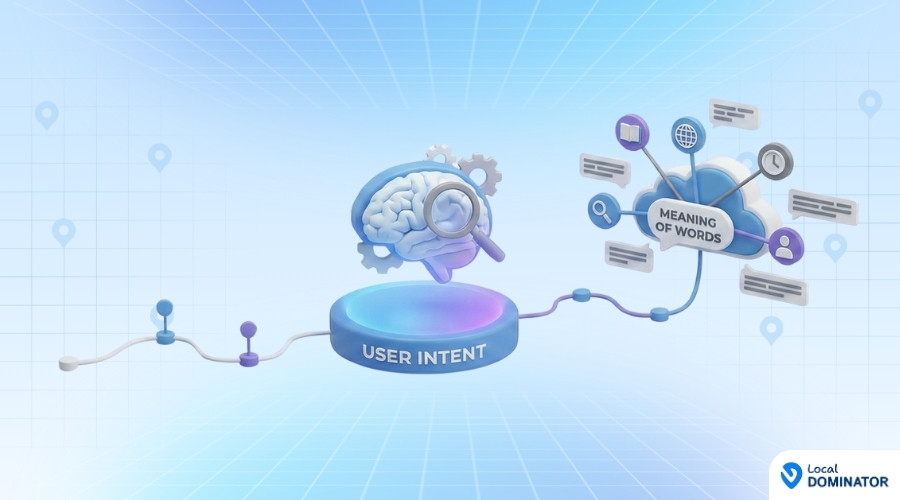
This focus on entities powers a technology called Semantic Search. This method attempts to understand the intent and meaning behind a query. It goes beyond the literal words typed into the search bar.
A search method that seeks to understand user intent and the meaning of words.
For example, a user might search for “cheap place to fix my car.” The keyword “mechanic” is not in the query. But a semantic search engine knows that a “place to fix a car” is a “mechanic.” It knows that “cheap” relates to “price range.” It looks for entities categorized as “Auto Repair” with a low “Price Range” attribute.
If your business is defined as an entity with these attributes, you can rank even if you do not have the exact keyword on your page. The engine understands the concept of your business. It matches the concept to the user’s needs. This is the power of entity optimization. It opens up visibility for a vast range of relevant queries.
How Does AI Verify a Business?
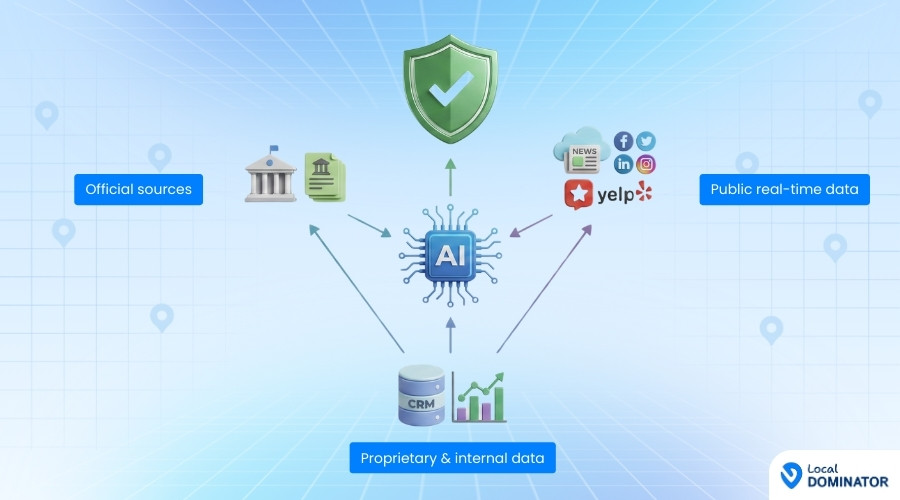
AI engines use a process called triangulation to verify business data. They cross-reference information across multiple independent sources to ensure consistency. This typically involves checking official government records, real-time public data like reviews, and internal business data. When these sources align, the AI assigns a high Confidence Score to the business.
AI models are paranoid. They are trained to be careful. They know that the internet is full of fake information. To protect users, AI engines use a verification process called Triangulation.
This process relies on three core categories of data:
1. Official and Authoritative Sources
This means using data from sites that everyone trusts. It includes government websites, business registries, and tax records. It also includes industry-specific organizations. For local businesses, Google Business Profile acts as a cornerstone authoritative source. AI algorithms rely heavily on this profile to establish the baseline truth of a business’s existence.
2. Publicly Available Real-Time Data
This category covers a vast range of online information that changes frequently. It includes news APIs, social media platforms, and online directories. AI systems scrape this data to check for current trends and sentiment. They look for mentions that corroborate what is found in official sources. If your business is mentioned in local news or has active reviews on Yelp, it strengthens this pillar.
3. Proprietary and Internal Business Data
AI systems can also incorporate a business’s own data to gain deeper insights. This includes data from Customer Relationship Management (CRM) systems or sales analytics. While this is often used for internal business intelligence, providing structured data feeds (like product inventory) to Google can help external AI models understand your current offerings.
The goal of this triangulation process is to increase confidence. When data from these independent sources aligns, it reduces the potential for Hallucination. It increases the credibility of the findings and makes the AI more likely to recommend your business.
The Roadmap to Entity Verification
Transforming your business into a verified entity requires a structured approach that mirrors the AI’s triangulation process. You must systematically address each data pillar: declaring your identity through code, establishing authority on seed sites, and maintaining strict consistency across the web. This sequence ensures search engines receive a clear, undisputed signal of your business’s reality.
You now know how the machine thinks. It looks for three things: a claim, a record, and proof.
To rank in AI results, you must build these three pillars yourself. You cannot wait for Google to find them. We call this the Entity Verification Framework.
It is a simple process:
- Step 1 (The Claim): You tell the AI who you are using code (Schema).
- Step 2 (The Record): You back that up with a trusted record (Seed Sites).
- Step 3 (The Proof):You prove you are active and consistent (N-A-P).
Follow these steps in order. Do not skip one. If you have a record but no claim, the AI gets confused. If you have a claim but no proof, the AI gets suspicious.
Step 1: Use the sameAs Schema Strategy
The sameAs schema strategy uses specific code to link a website to its official social and business profiles. This code tells search robots that different pages belong to the same business entity. It removes ambiguity and strengthens the business’s digital fingerprint. The code is placed in the website’s header using the JSON-LD format.
The best tool for this is Schema Markup. This is code that helps search engines understand your content. We use a format called JSON-LD. Google prefers this format because it is clean and easy to manage. It stays in your code and does not mess up the text on your page.
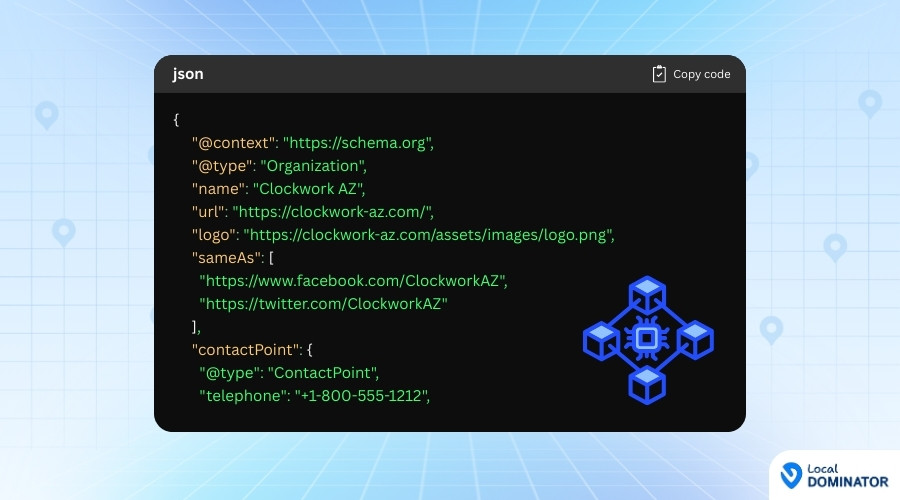
A simple code format used to describe your data to search engines.
Within this code, the sameAs property is the most critical for entity verification.
You do not need to be a developer to understand this. We focus on the LocalBusiness schema type. This tag basically tells search engines, “Hey, I am a real business with a physical location.”
Here are the key parts of the code you need to know:
| Property | What It Does | Example Data |
|---|---|---|
| @type | Tells Google your specific category. | LocalBusiness, Dentist, Plumber |
| @id | A unique ID for your business node. | https://www.yoursite.com/#org |
| name | Your official business name. | Elite Plumbing |
| image | The URL of your official logo. | https://www.yoursite.com/logo.png |
| telephone | Your primary contact number. | +1-555-0199 |
| address | Your physical street address. | 123 SEO St, Tech City, CA |
| geo | Your exact map coordinates. | 37.7749, -122.4194 |
| sameAs | Links to your other verified profiles. | https://twitter.com/brand",... |
Use the following template. You must replace the bold text with your actual business information. Do not leave the placeholder text.
					<script type="application/ld+json">
{
  "@context": "https://schema.org",
  "@type": "LocalBusiness",
  "name": "YOUR BUSINESS NAME",
  "image": "https://www.yourdomain.com/logo.jpg",
  "@id": "https://www.yourdomain.com/#website",
  "url": "https://www.yourdomain.com",
  "telephone": "+1-555-555-5555",
  "priceRange": "$$",
  "address": {
    "@type": "PostalAddress",
    "streetAddress": "123 Main Street",
    "addressLocality": "Your City",
    "addressRegion": "Your State",
    "postalCode": "12345",
    "addressCountry": "US"
  },
  "geo": {
    "@type": "GeoCoordinates",
    "latitude": 40.712776,
    "longitude": -74.005974
  },
  "openingHoursSpecification":,
      "opens": "09:00",
      "closes": "17:00"
    }
  ],
  "sameAs": [
    "https://www.facebook.com/yourbusiness",
    "https://www.twitter.com/yourbusiness",
    "https://www.linkedin.com/company/yourbusiness",
    "https://www.instagram.com/yourbusiness",
    "https://www.wikidata.org/wiki/Q1234567",
    "https://www.crunchbase.com/organization/yourbusiness"
  ]
}
</script>
Once you add this code, you must test it. Use the Rich Results Test tool from Google. This tool will scan the code. It will tell you if you made a syntax error and will show you exactly what Google sees.
If the test passes, Google will index the code. Over time, it will associate your website with the profiles listed in the sameAs section. This is the first step in building a verified entity.
Step 2: Secure Your Brand on AI "Seed" Sites
Seed sites are trusted databases that AI models use to train their knowledge. Key sites include Wikidata, Crunchbase, and the Better Business Bureau. Having a verified entry on these sites acts as a “source of truth” for AI engines. This allows the AI to confirm facts about a business with high certainty.
The sameAs strategy works best when you link to authoritative sources. You cannot just link to random websites. You must link to sites that the AI trusts. We call these Seed Sites.
A seed site is a database that is known for high accuracy. Search engines like Google use these sites to build their initial Knowledge Graph. If you are in the seed, you are in the Graph. If you are not in the seed, you have to work much harder to be recognized.
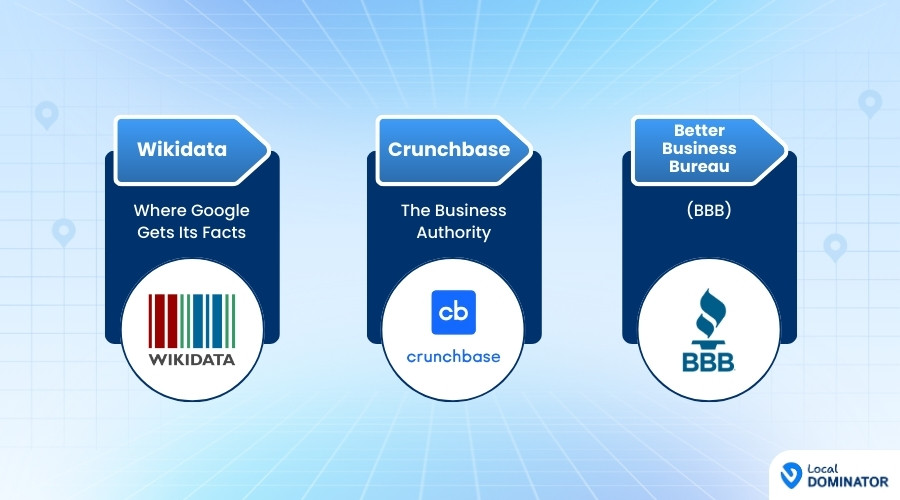
Wikidata: Where Google Gets Its Facts
Wikidata is the most critical database for verifying your business. It is a sister project to Wikipedia, but they serve different purposes. Wikipedia is for humans to read stories. Wikidata is for machines to read facts.
Google feeds its Knowledge Graph directly from this database. If you have a profile here, Google has a permanent record of you.
How to Get Listed on Wikidata
You cannot just create a page like you do on Facebook. Wikidata has strict rules. You must prove your business is “notable.”
- Check Your References:You need proof. Gather news articles, books, or links from reputable websites that mention your business.
- Create an Account:You must register to make edits.
- Build Your Item:Create a new item for your business. Add your name, description, and other names you go by.
- Add the Facts:Fill in the details. State that you are a "Business." Add your headquarters location and your founding date.
- Prove It:Every fact needs a reference link. Use the sources you gathered in step one.
A massive database that connects facts about people, places, and things.

Crunchbase: The Business Authority
Crunchbase is the standard for business data. It focuses on startups, funding, and technology. But it lists all types of companies. AI models use Crunchbase to verify if a company is active. They use it to verify leadership.
Why it matters:
Crunchbase data is structured. It lists the CEO, the founding date, and the funding rounds. This is exactly the type of data AI looks for to build a Knowledge Panel.
Action:
Create a profile. Verify it with a LinkedIn login. Keep the data fresh. If you hire a new executive, update Crunchbase.
Better Business Bureau (BBB)
For local businesses in North America, the BBB is a gold standard. It is a symbol of trust. A BBB accreditation proves that a business is legitimate. It proves that there is a real person behind the company who answers complaints.
Trust Signal:
AI interprets a BBB profile as a strong signal of Trustworthiness. This is a key component of E-E-A-T (Experience, Expertise, Authoritativeness, Trustworthiness).
Verification:
The BBB verifies your address and phone number physically. AI knows this. It trusts BBB data more than your own website.
The Essential Checklist of Trusted Seed Sites
You should aim to have a verified profile on as many of these sites as possible.
| Seed Site | Entity Type | Data Verified |
|---|---|---|
| Wikidata | All. | Identity, Relationships, IDs |
| Crunchbase | Companies | Leadership, Funding, Status |
| Companies/People | Employment, Professional History | |
| Better Business Bureau | Local Business | Legitimacy, Dispute Resolution |
| Bloomberg | Corporations | Market Data, Executive Profiles |
| Google Business Profile | Local Business | Location, Hours, Reviews |
| Apple Maps Connect | Local Business | Location (feeds Siri) |
| Bing Places | Local Business. | Location (feeds ChatGPT/Bing) |
Vertical-Specific Databases
Every industry has its own trusted databases. You must find yours.
- LawyersAvvo, Martindale-Hubbell.
- Doctors Healthgrades, RateMDs.
- RestaurantsYelp, TripAdvisor.
- SoftwareCapterra, G2.
The AI knows these are authority sites for your specific industry. Being listed here adds topical relevance to your entity. It tells the AI not just that you exist, but what you are.
Step 3: Maintain N-A-P Consistency for AI
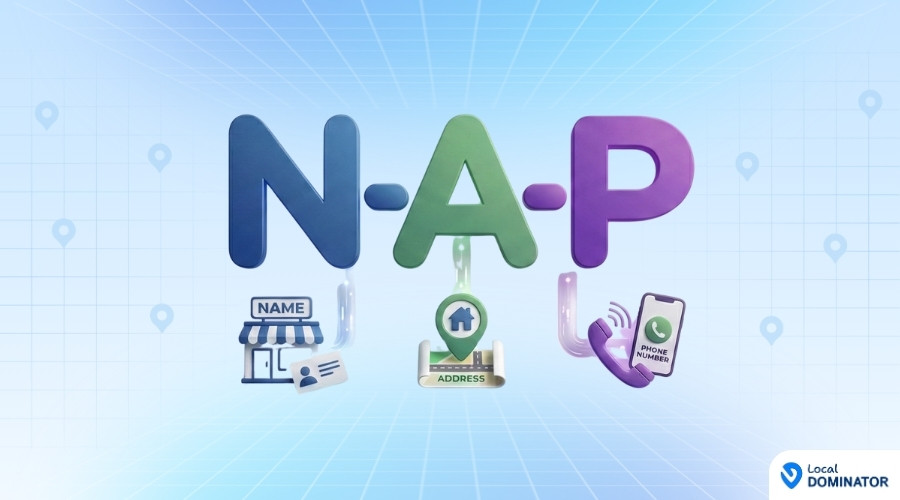
N-A-P consistency means that a business’s Name, Address, and Phone number are identical on every website. AI models are strict about formatting. Even small changes, such as using “St.” instead of “Street,” can lower a business’s trust rating. Consistency ensures that all data points verify the same entity.
The third pillar of verification is Proof. This proof comes from citations found across the web. AI engines scan millions of pages to find mentions of your business. Then, they compare those findings to the data on your website. This process relies on pattern matching. Unlike a human, the AI looks for exact matches. It lacks intuition, so it can be quite rigid.
(N-A-P)
An acronym for a business’s Name, Address, and Phone number.
Why AI Models Demand Exact Data
Humans instantly understand that “123 N. Main” and “123 North Main Street” are the same place. AI models, however, are often programmed to be literal. If the address format changes, the AI may stop verifying. It might assume the conflicting data belongs to two completely different companies. This error splits your ranking power between duplicate profiles.
- Business A: Elite Plumbing, 123 Repair Blvd.
- Business B: Elite Plumbing Inc, 123 Repair Boulevard.
To a conservative AI model, these might be treated as separate entities. This is a disaster for SEO. It splits your authority. It divides your reviews. It lowers your confidence score for both versions.
How Inconsistency Lowers Rankings
When an AI finds conflicting data, its confidence drops. It asks, “Is the business at 123 Repair Blvd? Or is it at 123 Repair Boulevard?”
If it cannot answer with 100% certainty, it will hesitate to show the business to a user.
Voice Search:
A voice assistant needs to be sure. It will not send a user to the wrong address. If the data is messy, it will skip your business and recommend a competitor with clean data.
Local Pack:
Google Maps ranks businesses based on data quality. Inconsistent citations are a negative ranking factor. They signal that the business is likely closed.
How to Audit and Fix Your Business Data
You must treat your N-A-P data like a brand asset. It must be perfect.
Establish a Master Record:
Decide on one format. Write it down.
- Name: Elite Plumbing (No “Inc” unless you use it everywhere).
- Address: 123 Main Street, Suite 100 (Spell out “Street”, “Suite”).
- Phone: (555) 123-4567 (Stick to one local number).
Audit the “Big Four”:
These are the primary data aggregators.
- Google Business Profile
- Bing Places
- Apple Maps
Use Automated Tools:
You cannot check every site manually. Local Dominator’s Citations Builder helps you scan the web to find incorrect N-A-P variations. It then allows you to fix them directly, ensuring your data is uniform across all directories.

How Data Aggregators Distribute Your Business Info
Data Aggregators are large companies that collect business data. They sell this data to smaller directories. The main ones are Foursquare and Data Axle (formerly Infogroup).
If your data is wrong at the aggregator level, it will be wrong everywhere. The error will trickle down to hundreds of small sites. You must fix the data at the source. Once you fix the aggregator, the correct data will eventually update across the ecosystem.
Why Small Errors Damage Your Visibility
It is easy to dismiss a wrong phone number in a small directory. But AI aggregates everything. If 20% of your citations have the wrong number, the AI sees a 20% error rate. This reduces its probability score.
AI models calculate the probability that a fact is true.
Fact:
“Phone number is 813-555-1234.”
Evidence:
80 citations say yes. 20 citations say no.
Result:
80% Confidence.
A competitor with 100% confidence will rank higher. In the world of AI, precision is power, which is why you must aim for 100% accuracy.
Automating Entity Verification with Local Dominator
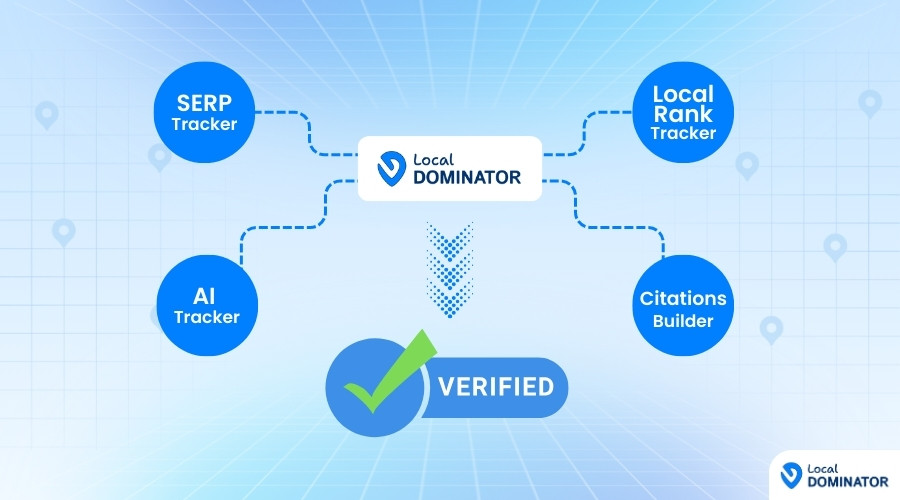
Local Dominator automates the entity verification process through a suite of specialized trackers and tools. The GeoGrid Tracker maps location authority, while the AI Tracker monitors brand mentions across LLMs like ChatGPT and Perplexity. Additionally, the SERP Tracker provides a unified view of organic and AI Overview rankings, ensuring your entity is visible across all search surfaces.
Keeping your business details consistent across the web is a difficult job. If you manage multiple locations, doing this by hand is nearly impossible. Local Dominator solves this problem. It automates the work to keep your data accurate across every platform.
GeoGrid Tracking
Most rank trackers clump your data into one confusing number. They mix up your ranking on Google Maps with your ranking in the Local Pack. This hides the truth.
Local Dominator tracks both views separately. You can see your visibility on the broad Google Map grid and your specific standing in the high-value Local Pack. This lets you distinguish between ranking because you are nearby (Proximity) versus ranking because you are a trusted brand (Prominence). This clarity helps you see the full picture. If you rank high on the map but low in the Local Pack, you know you need more trust. You can then focus on getting more reviews to boost your authority.
AI Tracker
Traditional SEO tools are blind to the new world of search. They track Google, but they ignore the AI engines stealing traffic. Local Dominator’s AI Tracker monitors your brand mentions across ChatGPT, Gemini, and Perplexity. This shows you exactly how often and where your brand appears in these new engines. It allows you to identify and fix “hallucinations” where AI models might be inventing false facts about your business.
SERP Tracker
The SERP Tracker gives you total situational awareness. It monitors your organic website link, your map listing, and your presence in AI Overviews all at once. Instead of fighting separate battles, you get a complete picture of your visibility in one dashboard. This helps you spot which keywords trigger AI Overviews so you can optimize your schema to capture those placements.
Automated Citation Management
Fixing directory errors one by one is a waste of time. Local Dominator’s Citations Builder automates this cleanup. It scans the web, finds inconsistent N-A-P data, and pushes correct information to hundreds of directories instantly.
Managing the Entity Lifecycle
Entity optimization is not a one-time task. It is a lifecycle.
- DiscoveryUse the Audit tool to find your baseline.
- CorrectionUse Citations Builder to fix N-A-P errors.
- OptimizationUse the GBP Management tool to post updates and keep the entity active.
- TrackingUse the AI Tracker to monitor your share of voice in ChatGPT and Google Gemini.
Frequently Asked Questions
How does ChatGPT know my business exists?
ChatGPT knows your business exists if you appear in its training data. This data comes from high-authority sources like Wikipedia, news articles, and common web crawls. By verifying your entity on Seed Sites like Crunchbase and maintaining consistent N-A-P data, you increase the chance that ChatGPT will include you in its next training update. The more consistent your data, the more likely the AI is to “learn” you accurately.
Why is my business missing from AI overviews?
Your business is missing because the AI lacks a high Confidence Score in your data. This happens if you have conflicting addresses online, no schema markup, or lack citations from trusted sources. The AI is programmed to be cautious; if it cannot verify your details via “Triangulation,” it will exclude you to avoid hallucination. Fix your N-A-P consistency to solve this.
How do I trigger a Google Knowledge Panel for my brand?
You trigger a panel by proving you are a notable entity. Claim your Google Business Profile. Add structured data (JSON-LD) to your homepage with sameAs links. Get cited in authoritative directories like Wikidata and the BBB. When Google’s algorithm accumulates enough consistent data points from trusted sources, it automatically generates the panel. You cannot buy one; you must earn it through data density.
What is entity verification?
Entity verification is the process of confirming a digital identity for search engines. It involves cross-referencing data from a website with external records like government databases, Wikidata, or the Knowledge Graph. It ensures that the “string” of text representing a name corresponds to a unique, real-world “thing.” This process prevents identity theft and confusion in search results.
How does N-A-P consistency affect my rankings?
N-A-P consistency is a fundamental ranking factor for local SEO and AI discovery. If your Name, Address, and Phone number vary across the web, search engines lose confidence in your data. They view this inconsistency as a sign of unreliability. This lowers your “confidence score,” causing your business to drop in rankings or disappear from the Local Pack entirely.


