

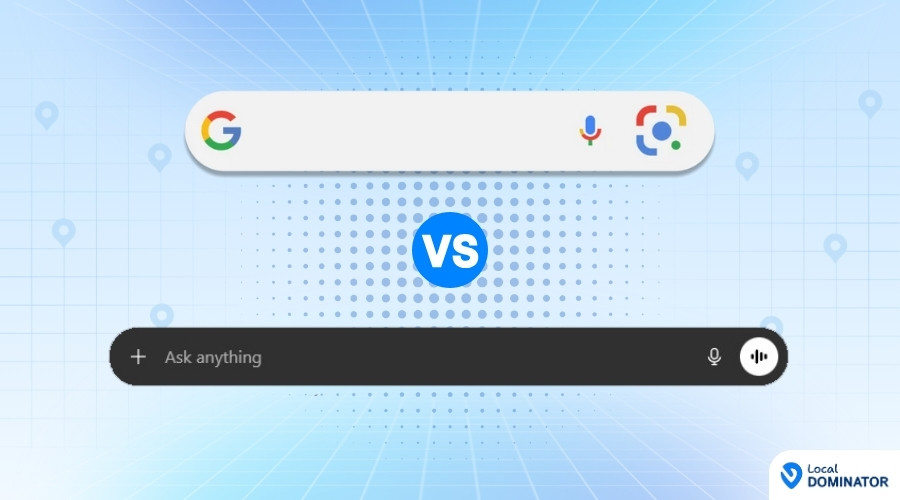
The main difference between traditional search and AI answers is simple: search engines give you a list of links to read, while AI gives you a direct answer. As we head into 2026, this change is causing a huge rise in zero-click searches. This means customers are finding your phone number and hours without ever visiting your website. To keep growing, local businesses need to stop worrying about website clicks and start focusing on “AI Share of Voice”, making sure AI tools trust your business enough to recommend it.
The Big Shift in Local Search
For over 20 years, the deal with Google was simple: they listed your website, and you got the customers. By now, that deal has changed. We are seeing a major shift where people are searching more than ever, but fewer people are clicking on websites. Why? Because tools like ChatGPT and Google’s AI Overviews read your website for the customer and answer their questions right on the search page. This isn’t the death of SEO, but it is a big change. To win in 2026, you need to stop chasing clicks and start chasing visibility.

The Real Difference Between Search and AI
To adapt, you need to know how AI search is different from the search engines we grew up with. Think of them as two very different types of assistants.
How They Work
Traditional Search acts like a librarian. It looks through millions of books (websites) and gives you a list of “blue links” where you might find your answer. You have to do the work of clicking and reading.
AI Answers act like an expert consultant. It reads the books for you. It combines information from different places and writes a simple, direct answer to your question.
What You Get
In traditional search, you get a list of choices. You might rank #1, but the customer still has to choose to click on you.
In AI search, you often get a single, confident recommendation. For example, if a user asks, “Who provides the best emergency plumbing services in San Diego”, the AI might just say, “To find the best fit, check recent reviews on Yelp/Google, look for licensed/insured companies like ASAP Drain Guys, and consider those offering guarantees or fast response times for your particular emergency.”
How People Use Them
This changes user behavior. People used to “search and click.” Now, they “ask and receive.” They want the answer instantly, without the extra work.

More Searches, Fewer Clicks
Data from late 2025 shows a startling stat: about 60% of all searches now end without a click to a website. This is what we call zero-click search.
This happens because AI Overviews answer questions right on the screen.
Simple Questions:
“What time does the Italian place close?” (The answer pops up instantly).
Comparisons:
“Compare the top three gyms downtown.” (The AI makes a comparison list for you).
For local businesses, this is risky. If your best offers, like “kids eat free on Tuesdays,” are hidden deep on your website, AI might miss them. You need to organize your online info so you become the answer, not just a link.
Why Google Search Console Is Not Enough
Some people think you cannot track AI search at all. That is not true anymore. Google updated its tools to help.
You can now use the AI Mode filter in Google Search Console. You can also look for long questions that people ask chatbots.
These updates are helpful, but they have a big problem. They only track clicks.
We already know that most searches end without a click. If Google’s AI recommends your business and shows your phone number, the customer will just call you. You get the customer, but Google Search Console reports zero results. It thinks you failed because nobody visited your website.
Also, Google provides numbers rather than context. It tells you that you appeared in a search. It does not tell you what the AI said about you. Did it say you were the best? Did it suggest a competitor instead? You have no way of knowing.
To fix this, you must stop tracking just website visits. You need to track your reputation.
This is where Local Dominator’s AI Tracker helps. Old tools wait for a click. Our tool looks at the actual answers inside ChatGPT and Google. It shows you the results that Google Analytics misses.
How AI Picks Business Recommendations
If AI isn’t just matching keywords, how does it choose who to recommend? It looks for “Entities.”
AI thinks of your business as a real-world object with specific facts (location, services, hours). To recommend you, the AI needs to be sure about these facts. It needs a strong “Clarity Signal.”
This depends on your business information consistency (Name, Address, Phone number). If your hours are different on Facebook, Yelp, and your website, the AI gets confused. To avoid giving wrong info (hallucinating), it will just skip you and recommend a competitor with clear data.
To make sure AI trusts you, your data must be perfect everywhere. Local Dominator’s Citation Builder scans the web to find and fix these errors. By cleaning up your digital footprint, you tell AI engines that your business is real, trusted, and safe to recommend.

Using Reviews to Teach AI
For local SEO in 2026, reviews do more than just build trust with humans; they teach AI models about your business.
AI reads reviews to understand feelings and specific details.
Old Way:
You just needed 5-star reviews to rank high on Maps.
New Way:
You need reviews that use the specific words AI is looking for.
If all your reviews just say “Great service,” the AI doesn’t learn much. But if a review says, “They fixed my heater in 20 minutes on a Sunday,” the AI learns that you are “fast,” handle “emergencies,” and work on “weekends.”
Strategy:
Ask customers to be specific. Ask them to mention the service they bought and the problem you solved. This feeds the AI the exact data it needs to recommend you next time.
Why Local Maps Still Matter
Even with fancy AI chatbots, location is still king. Even the smartest AI knows that a coffee shop 20 miles away is a bad answer for “coffee near me.”
However, there is a big difference between ranking on the Google Maps app and ranking in the Local Pack (the 3-business list you see on Google Search).
Google Maps mostly cares about proximity (who is closest?).
The Local Pack cares about reputation (who is best?).
This distinction is vital because AI models often look at the Local Pack results to make their list. If you only rank well on the Maps app because you are nearby, but you have a weak reputation, the AI will likely ignore you.
To get recommended by AI, you must prove you are the “best,” not just the “closest.”

Generative Engine Optimization (GEO): The New Playbook for Local Business
To win in this new world, traditional SEO is no longer enough. You need to practice Generative Engine Optimization (GEO).
GEO is the art of optimizing your content and data not just to be ranked by a search engine, but to be understood and recommended by an AI. While SEO focuses on keywords and links, GEO focuses on clarity, facts, and confidence.
If an AI isn’t 100% sure about your business hours or services, it won’t just rank you lower—it will leave you out of the answer entirely to avoid “hallucinating” incorrect information.
Here is your four-step GEO strategy to future-proof your business:
Step 1: Establish Data Integrity & Entity Confidence
For an AI to recommend you, it must trust that you exist and that your details are accurate. In the eyes of an AI, your business is an “Entity”—a data object with specific facts attached to it.
The Risk:
If your phone number on Facebook doesn’t match your Google Business Profile, the AI’s “confidence score” in your entity drops. It views your business as risky data.
The Fix:
You need a “Single Source of Truth.” Ensure your Name, Address, and Phone (NAP) are identical across the “Big Four” data aggregators and all major directories.
Step 2: Structure Content for Machines (The BLUF Method)
AI models are “lazy” readers; they prefer content that is structured for easy extraction. If your pricing or services are buried in long paragraphs, the AI might miss them.
The Strategy:
Adopt the “Bottom Line Up Front” (BLUF) rule. When creating service pages, answer the core questions (Who, What, Where, Cost) in the first 50 words using concise sentences.
Technical Edge:
Implement schema (specifically LocalBusiness and FAQPage schema). This code acts as a translator, handing the AI your business facts on a silver platter so it doesn’t have to guess. Level Up with sameAs and geo Tags To make sure AI fully understands your business, you need to be very specific in your code.
First, use the sameAs tag. This lists your other profiles, like your Facebook page, Yelp listing, or Chamber of Commerce profile. It tells the AI, “These profiles all belong to me.” This connects your website to your other trusted sources and prevents confusion.
Second, use the geo tag. This adds your exact GPS coordinates (latitude and longitude) to your code. It ensures the AI knows exactly where you are located on the map, which helps it understand your location relationships better than just a street address.
Step 3: Engineer Reviews for "Semantic Density"
In the era of AI Search, a 5-star rating is just the price of entry. To win the recommendation, you need reviews that are semantically dense—meaning they contain specific keywords and context.
Old Way:
“Great service, would recommend!” (The AI learns nothing specific here).
New Way: “They fixed my leaking water heater in San Diego on a Sunday morning.“
Why It Matters:
When a user asks, “Who offers emergency weekend plumbing?”, the AI scans reviews for those specific data points.
Action:
Adjust your review request campaigns to ask customers to mention the specific service they received and the problem you solved.
Step 4: Track Your "AI Share of Voice"
You can’t manage what you don’t measure. Traditional rank trackers only show you where you sit on a list of links. They are blind to the paragraph-style answers generated by ChatGPT, Claude, or Google’s Gemini.
The New Metric:
Move your focus to AI Share of Voice (SoV). This measures how frequently your brand is cited in AI answers for your target keywords compared to your competitors.
Use Local Dominator’s AI Tracker to monitor your mentions in generative results and identify “hallucinations” before they cost you customers.

Final Thoughts
The switch from traditional search to AI answers is here to stay. Tracking AI search visibility is now just as important as tracking keywords.
Businesses that hold on to old goals, like website traffic, will think they are failing, even if they are getting plenty of zero-click customers. Businesses that switch to new goals—like AI Share of Voice—will lead the market in 2026.
Don’t fly blind. The tools exist to help you win. Start tracking your AI performance today and future-proof your local business.
Frequently Asked Questions
How is AI search different from traditional search?
Traditional search engines give you a list of links to read. AI search engines read the content for you and write a direct answer, so you often don’t need to click anything.
Will AI answers replace my website?
No, but they change its purpose. Your website is now the “source of truth” that feeds the AI. You might get fewer random visitors, but the ones who do visit are usually ready to buy because the AI already answered their basic questions.
How do I measure my success in AI search?
You can’t use standard tools like Google Analytics to track brand mentions if no one clicks. You need special software, like an AI Tracker, to see your “Share of Voice,” which indicates how often AI recommends you.
Is SEO dead because of AI?
SEO isn’t dead, but it has changed. Instead of just using keywords, you now need to build trust. You do this with consistent data, detailed reviews, and clear content that AI can easily understand.
What does AI mean for local businesses?
AI is causing more zero-click searches. Customers get your hours or phone number right from the search result. This means your Google Map rankings and consistent business data are more important than ever, because AI uses them to answer customers.


