

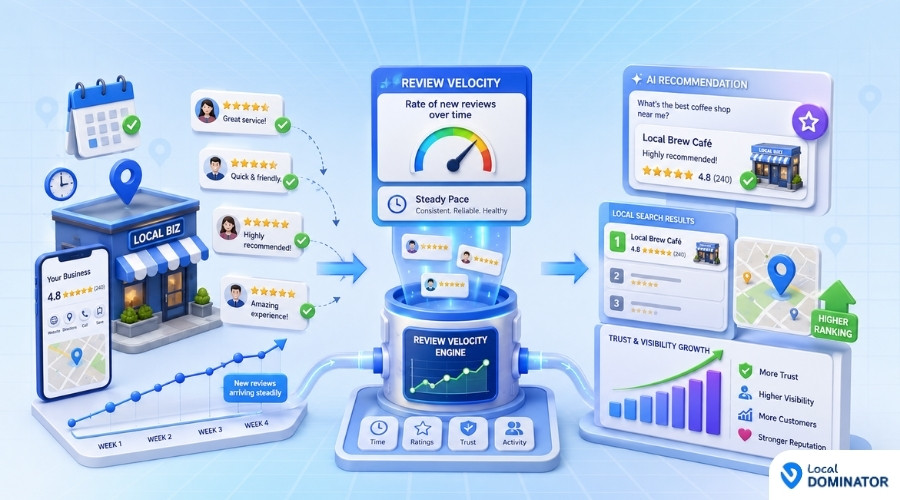
Review velocity is the exact rate a local business acquires new customer reviews over time. You might focus heavily on your total review count. However, search algorithms track the steady pace of new reviews to verify your business is active and currently satisfying customers. High review velocity signals trust to Google and modern AI engines, which directly improves local map rankings and your overall search visibility.
Watch the Full Strategy Breakdown
Want to see exactly how the top local SEO agencies are tracking review velocity and beating their competitors in AI search? Watch our full deep dive below, or keep reading for the complete strategy.
Why Review Pacing Beats Total Review Count
Review velocity tracks how often you get new customer reviews. Search engines and AI algorithms look at this pace to confirm your business is active and providing good service right now. Consistent new reviews build trust and push local map rankings higher than old, inactive reviews.
Total Reviews vs. Consistent Growth
Total review count displays historical authority. Consistent acquisition proves present reliability. Earning 100 reviews three years ago will not protect your rankings today if competitors get 10 new reviews every week. Google requires a natural, ongoing pace of feedback.
Search algorithm experts warn that irregular bursts of reviews trigger red flags. Earning 50 reviews in one day followed by two months of silence looks suspicious to spam filters. A healthy review velocity means acquiring feedback consistently as a normal part of your daily operations.

Why AI Search Engines Need Constant Fresh Reviews
AI search engines require continuous user feedback to deliver accurate business recommendations. ChatGPT and Claude prioritize recent review data to measure current customer satisfaction. If you stop getting reviews, AI tools assume your business is irrelevant and stop recommending you in search summaries.
How Claude and ChatGPT Read Google Reviews
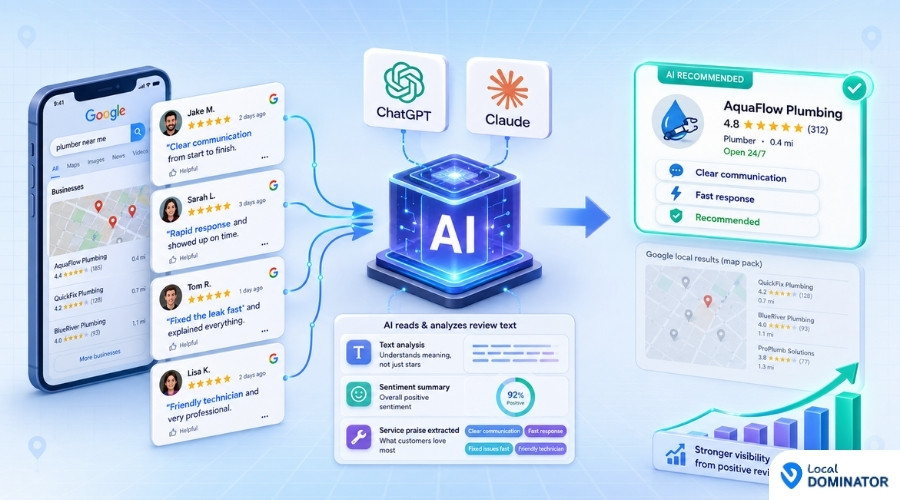
When users ask AI engines to recommend a local service, the AI reads, analyzes, and summarizes the text of recent Google reviews.
Recent industry tests confirm this behavior. Prompting Claude to find a local plumber causes the AI to bypass standard map pack winners. Instead, it recommends specific businesses based entirely on review sentiment. The AI highlights companies specifically praised for clear communication and rapid response times.
If you want AI engines to recommend your local business, your reviews need to highlight specific services and positive customer experiences.
How AI Actually Reads and Recommends Customer Feedback
Modern AI search engines like ChatGPT and Claude don’t just rely on their original training data. When a user asks for a local recommendation, the AI uses a process called Retrieval-Augmented Generation (RAG) to pull real-time facts from live search indexes and map databases. Because these engines want to provide the safest, most accurate answers, they lean heavily on your recent customer reviews.
Here is how that retrieval process works behind the scenes:
The Live Retrieval
Instead of scanning the entire internet from scratch, the AI instantly queries search partners and local map caches—such as Google Maps or Bing Places—to pull your most up-to-date reviews.
The Context Check
The system reads the actual text to spot sentiment and specific details. If your recent reviews consistently praise your “fast late-night emergency repairs,” the AI extracts that exact context to match specific user requests.
The Final Recommendation
AI engines view stale business profiles as a high risk. The model builds its final answer by heavily favoring businesses that prove they are currently active and reliable through a steady stream of fresh reviews.
Ultimately, your review velocity ensures that whenever an AI checks a search index, it finds current proof of your quality. If you want to understand the mechanics behind this, you can read more about how AI models use live retrieval to evaluate public data.
How Review Consistency Drives Google AI Overviews and LSAs
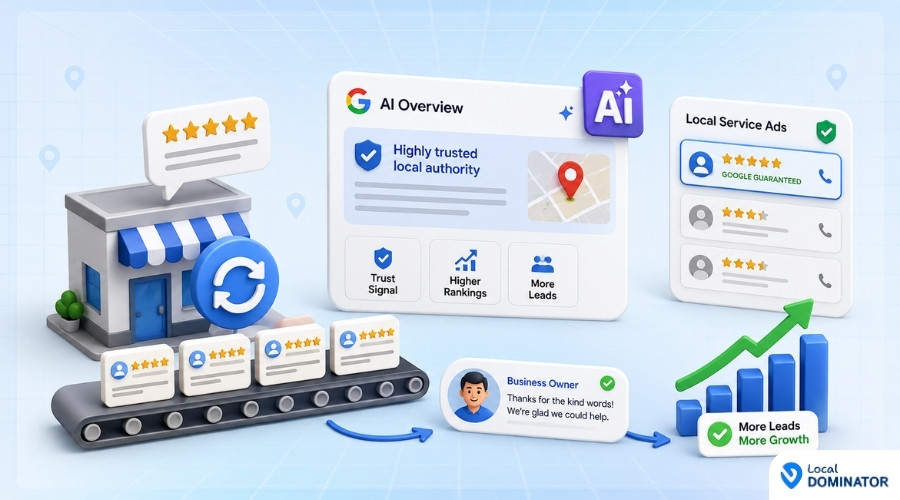
A continuous flow of new reviews trains Google AI Overviews to present your business as a highly trusted local authority. When you combine steady positive feedback with rapid owner responses, you directly improve your Local Service Ads placement and increase your lead volume.
Earning Recommendations Over the Traditional Map Pack
AI Overviews pull facts directly from recent customer feedback. If you consistently earn detailed Google reviews, the search engine will highlight your specific business attributes directly in the top search summary.
A steady pace of new reviews gives Google fresh content to crawl, while a stagnant profile gives AI engines nothing to talk about. Maintaining a healthy review velocity ensures your profile constantly updates with new keywords, services, and location data.
The Hidden Ranking Factor for Local Service Ads
Local Service Ads (LSA) rely heavily on trust signals. While your review velocity keeps your profile active, your response rate protects your actual lead flow.
Ignoring feedback actively hurts your LSA rankings. If you receive a bad review and leave it unanswered, Google’s algorithm registers a drop in customer care. This single ignored review can tank your lead volume the very next month. To protect your visibility, you must reply to every review quickly.
How to Safely Close the Review Gap with Competitors
You close a competitor review gap by calculating how many new reviews you need per month and pacing that growth over time. Rushing the process triggers spam filters. A controlled, monthly strategy builds authority safely and helps you outrank competitors.
The 1-Month vs. 7-Month Growth Strategy
You cannot close a massive review gap overnight without triggering Google’s spam filters. A sudden influx of reviews flags your account for manipulation. To close the gap safely, you need a calculated timeline that spreads the acquisition out.
Using the Local Dominator Review Velocity Tool helps you map out this exact numerical strategy. It shows you exactly how many reviews you need each week to overtake competitors without putting your local listings at risk.
How to Turn Competitor Flaws into Winning Comparison Pages
You can use your competitors’ negative reviews to directly highlight your own business strengths. When frustrated customers start searching for alternatives to a poorly performing company, they are usually ready to buy. By identifying recurring problems—like chronic no-shows or unexpected markup fees—you can create website content that proves your service solves those exact pain points. This strategy allows you to capture highly qualified search traffic right when local customers are looking for a reliable switch.
Spotting Recurring Flaws in Competitor Reviews
Competitor review analysis reveals the exact reasons why local customers leave 1-star ratings. Instead of guessing what your market cares about, you can use Local Dominator to instantly scan hundreds of competitor reviews and extract their most common operational failures.
The tool helps you quickly spot recurring local service themes, such as:
High-Pressure Sales Tactics
Customers feel pushed into decisions before they are ready.
Bait-and-Switch Estimates or Hidden Fees
Unexpected charges can make customers lose trust quickly.
Consistent appointment no-shows and late arrivals.
Repeated scheduling issues frustrate customers and disrupt their day.
Poor communication or leaving job sites messy.
Customers expect clear updates and a professional cleanup process.
Once you know a major competitor frequently misses appointments, you can adjust your reputation management strategy to put your own reliability front and center. You can immediately update your website and Google Business Profile to emphasize your own on-time guarantees and direct communication, turning their biggest weakness into your unique selling proposition.
Feeding Factual Comparisons to AI Crawlers Safely
You can build comparison content on your website to highlight these competitor weaknesses without sounding aggressive or unprofessional. Instead of directly attacking a local competitor by name (which can spark unnecessary disputes), you can create a section comparing your business to “standard industry practices.”
To maximize visibility and capture the right search intent, place this comparative content on your highest-converting pages:
Location Pages
This is the most effective placement. Add an H2 section titled “Watch Out for Hidden [Industry] Fees in [City].” This puts the comparison exactly where local customers and AI engines are looking for area-specific services.
Specific Service Pages
If competitor reviews reveal they struggle with a specific offering, embed a comparison table directly on your corresponding service page to show why your process is superior.
“Why Choose Us” Pages
Use this page to compile common industry-wide complaints and contrast them with your own successful track record.
To execute this effectively, look at a competitor’s negative review complaining about unexpected upcharges. Build the recommended section on your location page and clearly outline how your business uses transparent, upfront estimates. To back up your claim, add a callout box linking directly to your own Google reviews where real customers praise your honest pricing.
This method gives Google and AI engines clean, factual review data to crawl. It logically proves you offer a superior service based on actual customer sentiment, positioning you as the most reliable choice in your area.
How to Automate Your Review Growth and Track AI Mentions
Automating review requests ensures you acquire new ratings at a steady pace without manual work. Tracking software lets you filter out negative feedback internally while monitoring exactly how major AI engines mention your brand online.
Generating Review Links and Filtering Bad Feedback
Asking for reviews manually limits your velocity. You must automate the process. When a job is marked complete in your CRM, trigger an automated SMS containing a feedback link.
If the customer had a positive experience, the link directs them to your Google Business Profile. Ask them to upload a photo with their review. Images carry massive weight in local search. If they had a negative experience, the link directs them to an internal intake form. This catches bad feedback before it goes public on Google, protecting the foundation of your local SEO strategy.
Using Local Dominator to Track Brand Mentions Across AI Engines
You need to know how AI engines perceive your business. Standard rank trackers only check Google Maps, which leaves a massive blind spot in your modern search strategy. AI engines pull data entirely differently than traditional search algorithms.
The AI Visibility Tracker monitors six major platforms simultaneously. It shows exactly when and how AI recommends your business, allowing you to refine your local SEO strategy for ChatGPT based on real-time brand mentions.

Frequently Asked Questions
What is review velocity in local SEO?
Review velocity is the speed and consistency at which a business acquires customer reviews over time. Search algorithms use this steady flow of reviews to verify that a business is currently active, relevant, and trusted by consumers.
Does Google care how fast you get reviews?
Yes. Google algorithms monitor the pace of review acquisition to detect spam. Receiving an unnatural spike of reviews in a short period triggers fraud filters. Google prefers a steady stream of reviews that matches the natural operation of your business.
How does ChatGPT recommend local businesses?
ChatGPT recommends local businesses by analyzing online directories, websites, and review platforms. It evaluates the sentiment, frequency, and specific details mentioned in customer reviews to provide users with businesses that have strong, recent positive feedback.
What happens if a local business gets too many reviews at once?
If a local business gets too many reviews at once, Google flags the account for suspicious activity. The algorithm filters or deletes the sudden influx of reviews. The business profile can face a temporary suspension for violating fake engagement policies.
How do I calculate the review gap against my competitors?
To calculate the review gap, subtract your total review count from your competitor’s total review count. Divide that number by the amount of months you want to take to catch up. This gives you the exact number of new reviews you must acquire each month to close the gap safely.


